![[a barriga de um arquitecto]](https://blogger.googleusercontent.com/img/b/R29vZ2xl/AVvXsEh4jxSFgS7aN5np9gNAv5D6FLs8GihH_1lu1XrTdi7CmZ6DwtdH1DQ7u6RQnN6SosH_HFrY3YQzoLlvzBeEK-cxh0dveIqPEsEC661K_iPUh0NifbNNN-mRoy6nVc0ycEi972Llyg/s1600/bA_LOGO_MOCHA_2016_650.jpg)


Uma das distinções mais significativas que se podem estabelecer quanto à produção arquitectónica contemporânea refere-se não a dimensão mas a economia. Mais precisamente no que respeita a considerações de custo-benefício – ou como os arquitectos abordam o problema da adequação entre os meios e os fins do desenho da arquitectura.
Considero este tema muito relevante não só porque não estamos todos a projectar para o Dubai mas porque este sentido de adequabilidade está no íntimo do que deveria ser uma prática sustentável. A ética da sustentabilidade depende precisamente de combater “obesidades” supérfluas. O design – ainda mais no domínio da arquitectura – é em tudo um exercício de adequabilidade, de eficácia, da descoberta da relação essencial entre as condições presentes e os requisitos de transformação, de introdução do que é novo. Isto não deverá ser visto como um obstáculo à inovação, antes o contrário. Num mundo sem restrições financeiras qualquer um pode erguer sensacionais ícones, obras de arte que não são necessariamente obras de arquitectura inovadoras. O oposto, no entanto, é possível. Fazer mais com menos. Superar um orçamento restrito através de soluções excepcionais de design e assim gerar objectos de genuína singularidade.
Estes pensamentos ocorrem-me ao contemplar o projecto do belo centro comunitário de Dønning, um equipamento de uso cívico projectado por Einar Jarmund e Hâkon Vigsnæs.
Esta equipa de arquitectos noruegueses tem recebido atenção crescente, com particular incidência sobre os seus notáveis edifícios de habitação unifamiliar. Mas este projecto em particular parece-me muito tocante, sendo um dos seus trabalhos menos sofisticados. Uma criação que se distingue por uma crua materialidade.
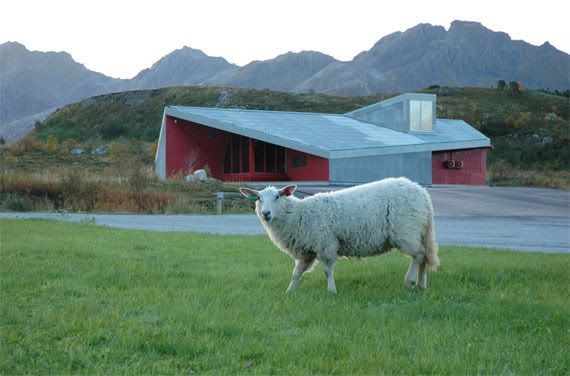
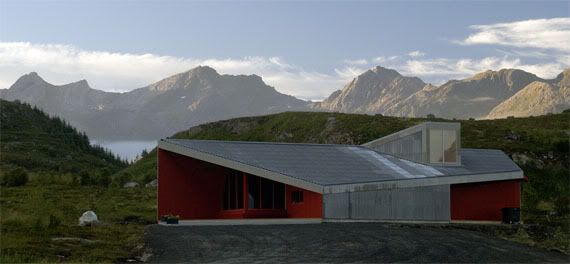
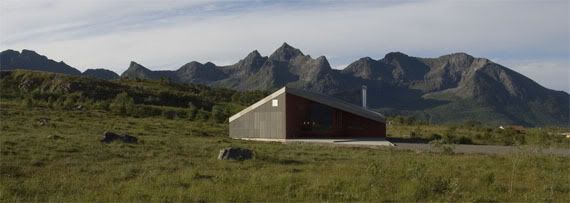
Este clube para jovens proposto para uma organização comunitária local é um exemplo de como a arquitectura pode transpor todas as limitações que sobre ela incidem. O desenho estrutural é simples e eficaz, preocupação a que não está ausente a optimização económica daquele que é pouco mais do que um pavilhão de formas levemente contorcidas. As aberturas são poucas mas proeminentes, oferecendo não apenas uma solução energeticamente eficiente mas também um uso deliberado da luz natural. O revestimento exterior resulta da aplicação de painéis de fibrocimento pré-moldados; outra opção de baixo orçamento a que o uso de cores contrastantes – o cinzento natural e o encarnado – providencia um forte efeito visual.
Na sua simplicidade e tensão de forma o centro comunitário de Dønning apresenta-se como uma afirmação singular, um gesto de singela humanidade no meio da vasta paisagem.
One of the most significant distinctions one can make in architecture today is probably not regarding dimension but economy. More precisely regarding cost-effectiveness concerns – or how architects approach the issue of adequacy between the means and the ends of architectural design.
¶ Read the rest of this entry
I find this matter extremely relevant not only because we’re not all designing for Dubai but as this sense of adequacy is at the core of what should be a sustainable practice. The ethics of sustainability rely precisely on fighting superfluous “obesities”. Design – even more so in architectural design – is all about adequacy, about effectiveness, about finding the essential relationship between the present conditions and that which needs to be introduced as new. This should not be seen as an obstacle to innovation; in fact it’s very much the opposite. In a world without budget restrictions anyone can exert sensational icons, works of art that are not necessarily innovative works of architecture. The opposite, however, is possible. To do more with less. To overcome a constricted budget through exceptional design and generate objects of true singularity.
These thoughts come to mind as I reflect on the beautiful Dønning Community Building, a civic facility designed by Einar Jarmund and Hâkon Vigsnæs.
This team of Norway-based architects has been receiving growing attention lately, mostly for their outstanding housing projects. But this one I find particularly moving as it almost resonates with Kuma’s theory of “weak buildings”. The Dønning facility is probably one of their less sophisticated projects, a distinctive creation of raw materiality. This youth club proposed for a local community organization is a brilliant example of how architecture can rise above enveloping limitations. Structural design is simple and cost effective: almost a warehouse of slightly convoluted forms. The openings are few but prominent, providing both an energy efficient solution and a deliberate use of natural light. The external skin is made of corrugated fiber cement boards; another low budget option to which the use of contrasting colors – natural grey and red – provide dramatic visual effect.
In its simplicity and tension of form, the Dønning Community Building stands as a singular statement, a bare gesture of unadorned humanity in the midst of a wide, sensational landscape.
Nota: o projecto do Centro Comunitário de Dønning foi apresentado recentemente no Arch Daily onde poderão encontrar bastantes imagens e, melhor ainda, uma colecção de desenhos técnicos. Está igualmente publicado na revista a+t Civilities II.
Note: the Dønning Community Building was recently published on Arch Daily where you can find many images and, better yet, a full set of technical drawings. It is also featured on a+t Civilities II magazine.
Architecture: Jarmund/Vigsnæs AS Architects MNAL.
Photography: Jarmund/Vigsnæs AS, John Stenersen.
External references: a+t Civilities II, Arch Daily.
These thoughts come to mind as I reflect on the beautiful Dønning Community Building, a civic facility designed by Einar Jarmund and Hâkon Vigsnæs.
This team of Norway-based architects has been receiving growing attention lately, mostly for their outstanding housing projects. But this one I find particularly moving as it almost resonates with Kuma’s theory of “weak buildings”. The Dønning facility is probably one of their less sophisticated projects, a distinctive creation of raw materiality. This youth club proposed for a local community organization is a brilliant example of how architecture can rise above enveloping limitations. Structural design is simple and cost effective: almost a warehouse of slightly convoluted forms. The openings are few but prominent, providing both an energy efficient solution and a deliberate use of natural light. The external skin is made of corrugated fiber cement boards; another low budget option to which the use of contrasting colors – natural grey and red – provide dramatic visual effect.
In its simplicity and tension of form, the Dønning Community Building stands as a singular statement, a bare gesture of unadorned humanity in the midst of a wide, sensational landscape.
Nota: o projecto do Centro Comunitário de Dønning foi apresentado recentemente no Arch Daily onde poderão encontrar bastantes imagens e, melhor ainda, uma colecção de desenhos técnicos. Está igualmente publicado na revista a+t Civilities II.
Note: the Dønning Community Building was recently published on Arch Daily where you can find many images and, better yet, a full set of technical drawings. It is also featured on a+t Civilities II magazine.
Architecture: Jarmund/Vigsnæs AS Architects MNAL.
Photography: Jarmund/Vigsnæs AS, John Stenersen.
External references: a+t Civilities II, Arch Daily.
Sem comentários:
Enviar um comentário